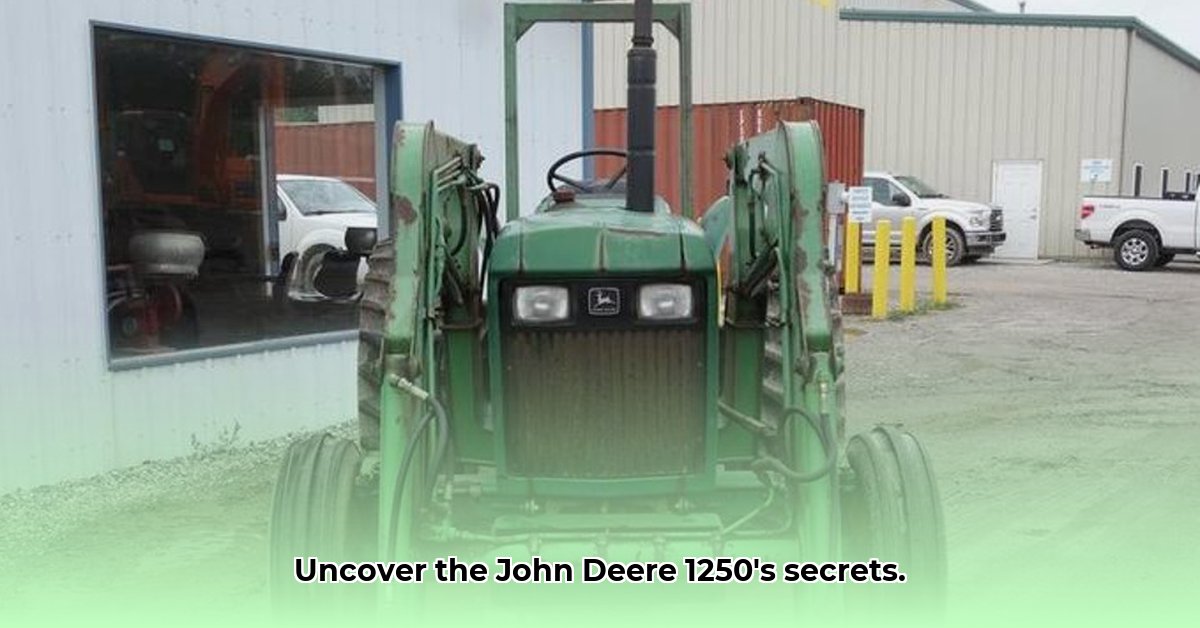
The John Deere 1250 tractor, a testament to a simpler era in agricultural technology, offers a compelling blend of vintage charm and practical functionality. This comprehensive guide explores its specifications, history, performance, maintenance, and current market value, providing invaluable insights for prospective buyers and current owners alike. This compact machine, uniquely built by Yanmar for John Deere, targets small farms and landscaping businesses seeking a reliable workhorse. For more info on maintaining its hydraulic system, check out this useful resource: hydraulic oil guide. But does it still hold up today? Let's find out.
Specifications and Features: A Closer Look
The heart of the John Deere 1250 is a Yanmar 3T95, a robust 2.3-liter three-cylinder diesel engine. This engine delivers approximately 44 PTO horsepower (power take-off, used to power implements), making it ideal for tasks such as tilling smaller plots, mowing, and light haulage. Its nine forward and three reverse gears provide ample versatility for various terrain and tasks. The fuel tank, with a capacity of 17.2 gallons, makes frequent refueling unnecessary. Available in both two-wheel drive (2WD) and four-wheel drive (4WD) configurations, this tractor catered to a range of user needs.
Here's a detailed breakdown of its key specifications:
| Feature | Specification | Notes |
|---|---|---|
| Engine | Yanmar 3T95, 3-cylinder diesel | Known for reliability and ease of maintenance. |
| Horsepower (PTO) | Approximately 44 hp | Sufficient for smaller-scale agricultural and landscaping tasks. |
| Transmission | 9 forward, 3 reverse gears | Offers flexibility for diverse operating conditions. |
| Fuel Capacity | 17.2 gallons | Relatively small, reducing the frequency of refueling. |
| Drive Type | 2WD or 4WD (optional) | 4WD models are rarer and generally more valuable. |
| Hydraulics | Basic system (details vary) | Adequate for most light-duty implements. |
A Legacy of Simplicity: The 1250's Historical Context
Produced between 1982 and 1989, the John Deere 1250 represents a specific point in agricultural technology. This collaboration between John Deere and Yanmar resulted in a tractor prized for its straightforward mechanical design, a welcome simplicity compared to modern tractors. Its target market consisted primarily of small farms, landscapers, and hobby farmers who required a dependable, easy-to-handle machine for a variety of light-duty tasks. This tractor's mechanical simplicity often translates into easier maintenance and repairs for those with basic mechanical skills.
Performance and Capabilities: Strengths and Weaknesses
The John Deere 1250 excels in tasks perfectly matched to its power and size. Mowing, tilling small areas, light haulage, and general farm utility are all well within its capabilities. Its compact design makes it incredibly maneuverable, a significant advantage in tight spaces. However, its limitations are equally important to note. Its 44 PTO horsepower restricts its suitability for heavy-duty applications like plowing large fields or operating heavy implements. While robust, its mechanical systems are less fuel-efficient and technologically advanced than those in modern tractors. This translates into potentially higher fuel consumption and longer completion times for some tasks.
Maintenance and Parts Availability: The Challenge of Vintage Ownership
Maintaining a vintage machine like the 1250 presents unique challenges. Parts availability can be a significant hurdle. While some common parts remain obtainable through John Deere dealers or online retailers specializing in classic tractors, others may require more resourceful sourcing, such as salvage yards or online enthusiast forums. Repair costs can vary greatly depending on the needed part and the labor involved. Online communities and specialized parts suppliers are invaluable resources for locating parts and troubleshooting issues. Consider establishing a relationship with a mechanic experienced in servicing older equipment.
Current Market Value: Factors Affecting Price
The value of a John Deere 1250 varies considerably based on several factors. The overall condition is paramount; a well-maintained example will fetch a higher price. Rarity also impacts value, with 4WD models commanding a premium due to lower production numbers. Critically, the ready availability of parts plays a major role. A tractor with easily accessible parts is significantly more valuable than one requiring extensive searching and potential fabrication. Checking online auction sites, forums, and classified ads provides insights into current market trends, but always conduct thorough research.
Conclusion: Is the John Deere 1250 Right for You?
The decision of whether or not to purchase a John Deere 1250 tractor is highly dependent on individual needs and priorities. Its maneuverability, simplicity, and suitability for light-duty work make it appealing for small farms and landscaping businesses or hobbyists with a knack for mechanics. However, its limited horsepower, aging technology, and challenges in parts acquisition might deter buyers prioritizing maximum power, efficiency, and minimal downtime. Thorough research, including seeking advice from experienced owners, is crucial before making a purchase.